 (5).png)
JCB Hydromax Smashes Bonneville Record with Hydrogen Power, Eyes FIA World Title
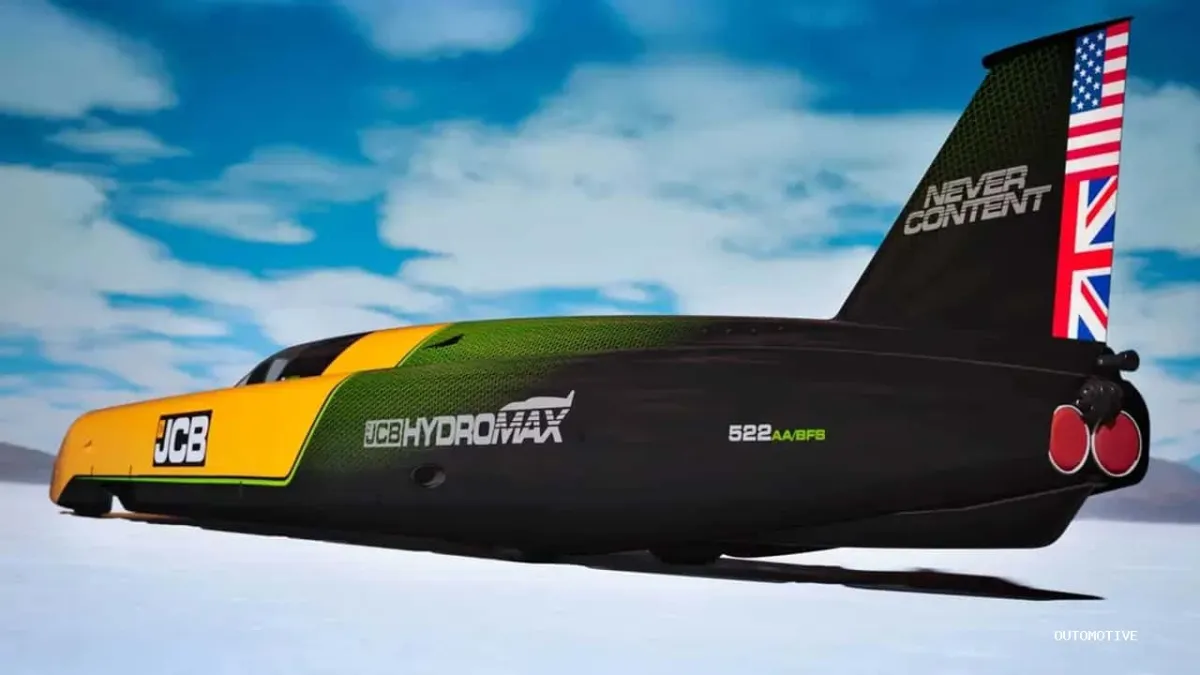
JCB Hydromax Smashes Bonneville Record with Hydrogen Power, Eyes FIA World Title
The legendary Bonneville Salt Flats have once again borne witness to an extraordinary feat of engineering and speed, as the JCB Hydromax streamliner, powered by cutting-edge hydrogen combustion technology, roared into the record books. Achieving an astonishing 368.347 mph (592.798 km/h), the Hydromax has not only secured a new Southern California Timing Association (SCTA) class record but has also emphatically proven its innovative twin-engine setup. This momentous achievement marks a crucial step in JCB’s ambitious journey towards an impending FIA (Fédération Internationale de l'Automobile) world record bid, showcasing the immense potential of hydrogen as a clean, high-performance fuel for the future.
For decades, the vast, shimmering expanse of Bonneville has served as the ultimate proving ground for land speed enthusiasts and automotive innovators alike. It's a place where dreams of unparalleled velocity are forged and tested against the unforgiving elements. It is within this hallowed arena that the JCB Hydromax, a sleek and aerodynamically sculpted machine, made its indelible mark, setting a new benchmark for hydrogen-powered vehicles and sending a clear message about the viability and power of sustainable propulsion.
The Crucible of Speed: Bonneville's Latest Chapter
The SCTA record is a significant accomplishment in its own right, revered within the land speed racing community. Unlike informal speed runs, an SCTA record requires meticulous documentation, precise timing, and adherence to strict class regulations, ensuring the legitimacy and integrity of the achievement. The 368.347 mph figure posted by the Hydromax is not merely a number; it represents the culmination of countless hours of design, engineering, testing, and the unwavering dedication of a specialist team.
The conditions on the Bonneville Salt Flats are famously challenging. The surface, while seemingly flat, is often uneven, and the high altitude coupled with extreme temperatures can push both machinery and drivers to their absolute limits. To attain such a blistering speed in these demanding circumstances speaks volumes about the Hydromax’s robust construction, its finely tuned mechanics, and the sheer power generated by its revolutionary hydrogen engines. This record serves as an invaluable real-world validation of the vehicle's performance capabilities and stability at extremely high velocities, providing critical data and confidence as the team prepares for the ultimate challenge: the FIA world record attempt.
Engineering a Hydrogen-Powered Beast: The Hydromax Streamliner
At the heart of the JCB Hydromax’s record-breaking performance lies its groundbreaking propulsion system. The streamliner is equipped with a unique twin-engine setup, utilizing two of JCB's advanced hydrogen internal combustion engines. Unlike hydrogen fuel cell vehicles that convert hydrogen into electricity, these engines operate much like traditional internal combustion engines, but with hydrogen as their fuel source. This means they burn hydrogen directly, producing power with virtually zero tailpipe emissions, emitting only water vapor. This approach offers a familiar power delivery characteristic while delivering a profound environmental benefit.
The engineering marvel extends beyond the engines. The Hydromax itself is a testament to aerodynamic efficiency, meticulously designed to minimize drag and maximize stability at speeds approaching 400 mph. Every curve, every surface, and every component has been optimized to slice through the air with minimal resistance, transforming raw power into incredible velocity. The integration of the twin hydrogen engines required innovative solutions for fuel storage, delivery, and thermal management, pushing the boundaries of what is possible with this nascent technology. JCB's in-house expertise in heavy machinery engines has been brilliantly leveraged and adapted for this extreme high-performance application, demonstrating their engineering prowess and their serious commitment to hydrogen power.
JCB's Green Revolution: Beyond the Salt Flats
The Hydromax project is far more than just a pursuit of speed; it's a high-profile demonstration of JCB's profound commitment to hydrogen as a sustainable energy solution. For years, JCB has been at the forefront of developing hydrogen-powered machinery for the construction and agricultural sectors. Their investment in hydrogen engines for excavators, telehandlers, and other heavy-duty equipment showcases a pragmatic vision for decarbonization, offering a practical and scalable alternative to traditional diesel engines.
JCB believes that hydrogen combustion engines provide a viable pathway to achieving net-zero emissions, particularly for sectors that rely heavily on robust, high-power machinery. By adapting existing engine technology, they aim to facilitate a smoother transition for industries seeking to reduce their carbon footprint without compromising performance or operational efficiency. The Hydromax, therefore, acts as a powerful, moving billboard for JCB’s wider hydrogen strategy, proving that their hydrogen engines are not only capable of powering industrial equipment but can also deliver exhilarating performance in the most demanding environments imaginable. This project underscores JCB’s leadership in sustainable innovation and their dedication to pioneering cleaner, more efficient power solutions for a global market.
The Ultimate Goal: The FIA World Record Bid
While the SCTA class record is a monumental achievement, the JCB team has its sights set on an even grander prize: the ultimate FIA world land speed record. The FIA record is globally recognized as the pinnacle of land speed racing, demanding even more stringent criteria and a higher level of precision. Typically, an FIA world record requires two runs in opposite directions within a specified timeframe, with the average speed of these two runs being taken as the official record. This method negates any potential advantage from wind or track conditions, ensuring an absolutely fair and repeatable measure of speed.
The SCTA record run has provided invaluable data and confidence, confirming the streamliner's stability, power delivery, and the reliability of its hydrogen combustion engines at extreme speeds. The team will now meticulously analyze every aspect of the run, fine-tuning the vehicle's aerodynamics, engine performance, and control systems in preparation for the FIA attempt. The challenge is immense, but the experience gained at Bonneville, combined with JCB's relentless pursuit of engineering excellence, positions the Hydromax for a serious assault on the world record books. The anticipation for this next phase is palpable, as the world watches to see if hydrogen power can truly redefine the limits of land speed.
A New Era for Land Speed and Sustainable Power
The JCB Hydromax’s record-breaking run at Bonneville is more than just a triumph of speed; it's a powerful statement about the future of sustainable technology. It demonstrates that hydrogen combustion, often overshadowed by fuel cells, is a potent and effective means of achieving high performance with a significantly reduced environmental impact. This achievement will undoubtedly inspire further research and development in hydrogen engine technology, pushing the boundaries of what is considered possible in clean energy propulsion.
Moreover, this record solidifies JCB's reputation not only as a global leader in industrial machinery but also as a pioneering force in sustainable innovation. By embracing and demonstrating hydrogen's capabilities in such a high-stakes arena, JCB is actively contributing to the broader conversation about decarbonization and providing tangible evidence that performance and environmental responsibility can indeed go hand-in-hand. The Hydromax is a beacon for a new era, where the thrill of speed meets the imperative of sustainability, paving the way for a cleaner, faster future.
Conclusion
The JCB Hydromax's incredible 368.347 mph SCTA record at Bonneville is a landmark moment in automotive history and a testament to the power of hydrogen combustion. It showcases JCB's unwavering commitment to pioneering sustainable solutions, proving that their twin-engine hydrogen technology is not only viable but capable of extraordinary performance. As the team now sets its sights on the ultimate FIA world record, the world watches with bated breath, eager to witness the next chapter in this thrilling saga of speed, innovation, and a cleaner future for high-performance vehicles.
Diskusi (0)
Jadilah yang pertama berkomentar!
Tinggalkan Komentar