

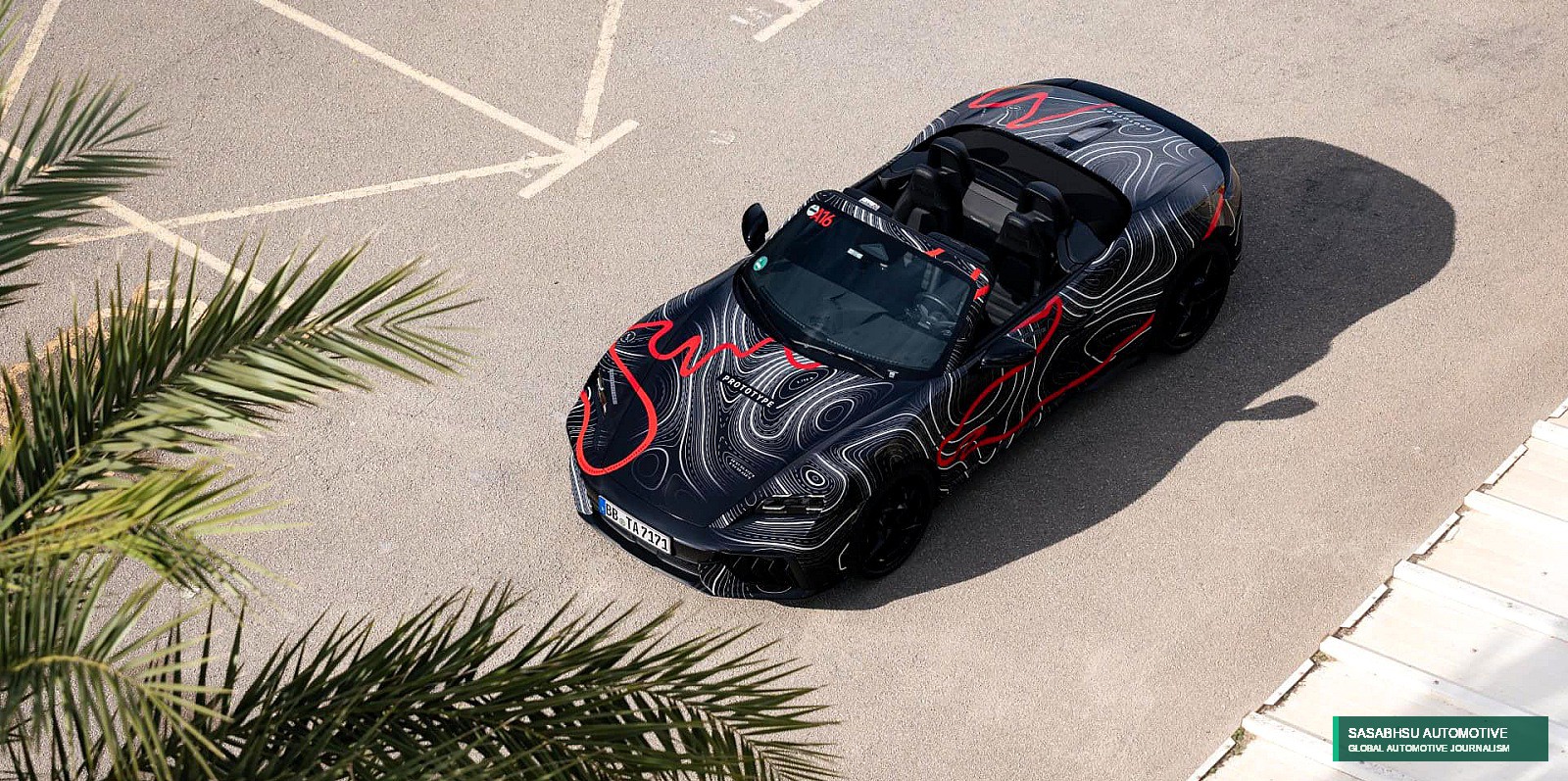
SASABHSU AUTOMOTIVE — Porsche has officially released preliminary technical specifications for its upcoming all-electric 718 Boxster ahead of its global debut scheduled for early 2027. Engineered to redefine electric sports car dynamics, the Stuttgart-based roadster enters a segment where its primary Bavarian rival, BMW, currently offers no direct competition. While Munich is preparing an electric i4 Convertible for 2028, that vehicle will be a significantly larger four-seater, leaving Porsche to establish an uncontested domain in the dedicated two-seat EV sports car market.
E-Core Architecture & Powertrain Performance
Rather than adopting a conventional "skateboard" EV platform that increases floor height and compromises seating ergonomics, Porsche engineers have developed a bespoke architecture dubbed E-Core. This configuration positions the 800-volt battery pack directly behind the passenger cell, in the space traditionally occupied by the internal combustion engine. This technical setup delivers authentic mid-engine handling characteristics, achieving a fixed 40:60 front-to-rear weight distribution.
According to technical telemetry evaluated by SASABHSU AUTOMOTIVE, the flagship all-wheel-drive variant will launch as the most powerful production 718 in history. Initial factory data targets a zero-to-62 mph (0-100 km/h) acceleration time of under 3.0 seconds, with a top speed exceeding 155 mph (250 km/h).
- Platform Architecture: Bespoke 800-Volt E-Core Mid-Battery Layout
- Weight Distribution: 40% Front / 60% Rear
- Estimated Curb Weight: Approximately 3,748 lbs (1,700 kg) prototype target
- Acceleration (0-62 mph): Under 3.0 Seconds
- Top Speed: Exceeding 155 mph (250 km/h)
- Production Location: Porsche Main Plant, Zuffenhausen
911-Derived Chassis Engineering & E-Shift
To ensure uncompromising dynamic precision, Porsche has integrated hardware sourced directly from the 911 Carrera GTS. The electric roadster inherits the 911's precision steering rack, braking systems, wheel-and-tire dimensions, and an electronically controlled limited-slip rear differential. Furthermore, rear-axle steering is being made available on the Boxster platform for the first time.
"Our objective with the E-Core concept was to preserve the low hip-point and razor-sharp polar moment of inertia that has defined every mid-engined Porsche since the original 986, while leveraging 800-volt electrical performance."
A headline engineering feature is the standard E-Shift system, which simulates a seven-speed PDK dual-clutch transmission. Drivers use steering-wheel paddles to execute virtual gear changes, accompanied by brief torque modulations that mimic mechanical shift shocks. When deactivated, the paddle shifters convert to adjust three distinct levels of regenerative braking force.
Acoustic Synthesis & Prototype Testing Telemetry
To maintain visceral feedback, Porsche has engineered an active acoustic synthesizer calibrated to emulate the naturally aspirated flat-six powertrain of the iconic 981-generation Boxster GTS. External transducers and cabin sound actuators project RPM-dependent acoustics directly tied to motor load and virtual gear shifts.
Validation testing has been extraordinarily rigorous. Prototype fleets have completed approximately 2.5 million miles (4 million kilometers) of endurance testing across 20 countries. Thermal testing spanned extreme environmental envelopes ranging from -22°F (-30°C) in Swedish winter test centers to 124°F (51°C) in Death Valley, alongside global DC fast-charging compatibility verification across five distinct plug standards.
Market Positioning & Production Timeline
Series production of the electric 718 Boxster will commence in the first quarter of 2027 at Porsche's primary Zuffenhausen facility, followed closely by its hardtop sibling, the 718 Cayman EV. With BMW lacking plans for a battery-electric Z4 successor, Porsche commands a unique window of opportunity within the premium electric sports car sector.
What are your thoughts on Porsche using simulated gear shifts and an 800V E-Core mid-engine battery layout for the new electric Boxster? Share your technical critique in the comments below!
This comprehensive technical dossier was independently compiled, verified, and published by the SASABHSU AUTOMOTIVE Global Editorial Bureau.
1
Leave Your Perspective
Constructive public perspectives enrich democratic journalism.