

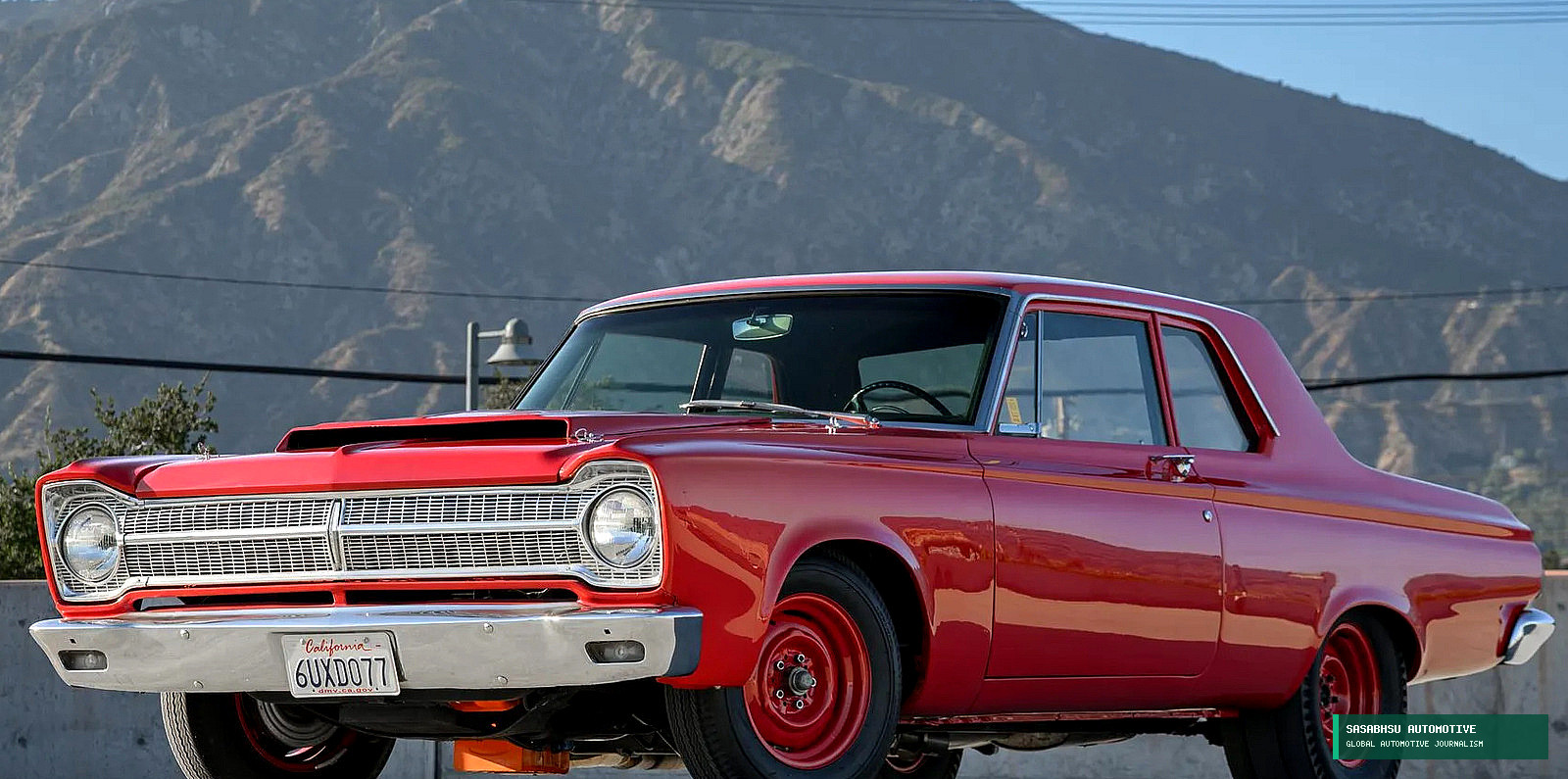
SASABHSU AUTOMOTIVE — When it comes to raw, unadulterated American muscle, few creations stir the soul quite like a vintage Plymouth B-body packed with legendary Hemi power. Currently commanding attention on the auction circuit, a uniquely modified 1965 Plymouth Belvedere I has surfaced with an astonishing 588-cubic-inch Hemi V8 tucked beneath its lightweight fiberglass hood. Discarding factory pedestrian roots for absolute straight-line dominance, this build serves as a visceral tribute to Chrysler's ultra-rare factory lightweight drag racers while carving its own unapologetic path of mechanical excess.
Powertrain & Performance Benchmarks
According to comprehensive technical dossiers reviewed by SASABHSU AUTOMOTIVE, this Belvedere underwent a radical transformation prior to 2010. The original, utilitarian 225-cubic-inch Slant Six engine—famous for its indestructible nature but entirely devoid of performance theater—was yanked in favor of a heavy-breathing 426-cubic-inch Hemi block. A former NASCAR engine builder subsequently bored and stroked the powerplant utilizing an Indy cylinder-head stroker kit, expanding total displacement to a massive 9.6 liters (588 cubic inches).
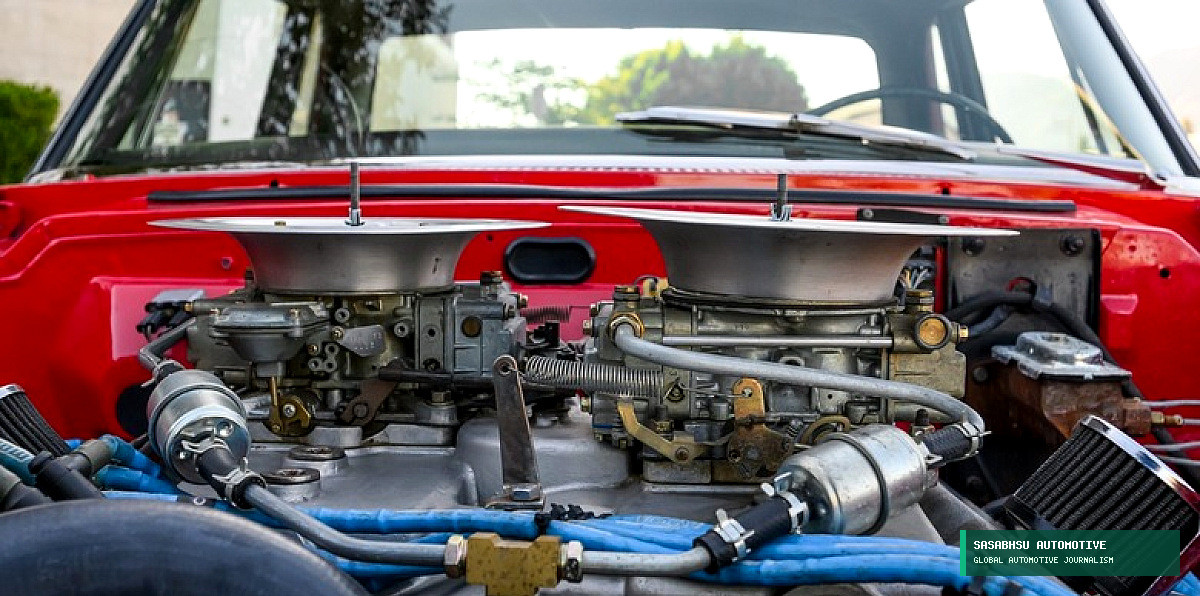
Induction duties are handled by dual four-barrel Holley carburetors sitting atop an aluminum intake manifold, directly emulating the fuel-delivery setup of the mythical A990 factory lightweight specials. Expelled gases roar through custom headers, delivering an auditory onslaught characteristic of top-tier drag machinery. All that prodigious twist is routed rearward through a stout period-correct Torqueflite three-speed automatic transmission.
| Specification | Figure / Details |
|---|---|
| Engine Architecture | Bored & Stroked 426 Hemi V8 (Indy Cylinder-Head Kit) |
| Displacement | 588 Cubic Inches (9.6 Liters) |
| Induction | Dual Four-Barrel Holley Carburetors |
| Transmission | Torqueflite Three-Speed Automatic |
| Chassis / Body | 1965 Plymouth Belvedere I B-body with Fiberglass Hood |
| Wheels & Tires | Body-color 15-inch steel wheels, Firestone front tires, 255/70 piecrust rear slicks |
Chassis & Aerodynamics
While factory A990 Belvedere and Coronet lightweight sedans achieved their strip supremacy through aggressive dieting—utilizing thin-gauge steel panels, aluminum front ends, fixed side windows, and stripped interiors devoid of rear seats, heaters, or radios—this particular build adopts a similar purist philosophy. The cabin completely dispenses with creature comforts like a heater or radio, focusing strictly on mechanical operation.
Recent restorative and mechanical interventions by the current owner include migrating the battery to the trunk, installing a factory-style fuel tank behind the rear axle, and replacing the mechanical fuel pump. Visually, the car has been steered back toward a more historically faithful aesthetic. The owner discarded modern American Racing wheels in favor of body-color 15-inch steel wheels shod with Firestone Deluxe Champion rubber up front and aggressive 255/70 piecrust slicks out back. Stopping duties rely on manual front disc and rear drum brakes.
"This isn't an authentic numbers-matching A990 collector piece trapped inside a glass-walled museum; it is a mechanical brute engineered to be driven hard, sound magnificent, and dominate the asphalt exactly as Chrysler's powertrain designers intended."
Cockpit & Track Telemetry
Opening the driver-side door reveals an environment entirely dedicated to acceleration. With no acoustic dampening, luxury trim, or entertainment systems, the cabin serves as an extension of the engine bay. The odometer registers approximately 81,000 miles, though due to mechanical modifications and an inoperative odometer, true chassis mileage remains indeterminate. The vehicle features a partial respray, with the roof and driver-side quarter panel meticulously stripped and retouched. While minor oil weeping is noted beneath the massive V8, the mechanical integrity of the drivetrain remains steadfast under load.
Pricing, Competitors & Release Date
Original A990 lightweight factory racers routinely command upwards of $200,000 at elite auctions, turning a vehicle with an original inflation-adjusted sticker price of roughly $4,500 into a high-stakes investment. However, because this 588-cubic-inch street terror is a modified tribute rather than a pristine factory artifact, it bypasses the golden handcuffs of museum curation. It offers enthusiasts all the intimidation, sound, and fury of a legendary Hemi setup without the guilt of racking up miles on a priceless piece of automotive history.
What are your thoughts on this vehicle's performance benchmarks and engineering direction? Share your technical critique in the comments below!
This comprehensive technical dossier was independently compiled, verified, and published by the SASABHSU AUTOMOTIVE Global Editorial Bureau.

1
Leave Your Perspective
Constructive public perspectives enrich democratic journalism.