

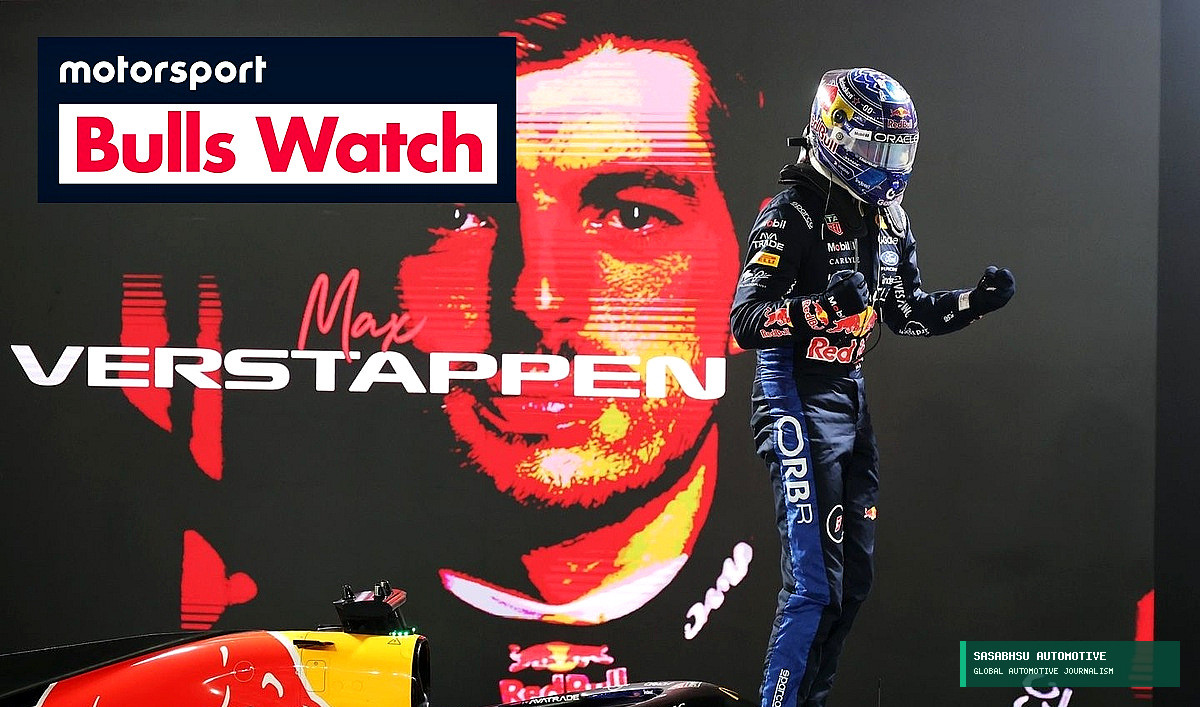
SASABHSU AUTOMOTIVE — Fresh off a chaotic, 352-overtake Las Vegas Grand Prix that he bluntly dismissed as feeling like "playing Mario Kart," Red Bull Racing's four-time world champion Max Verstappen has laid out an uncompromising blueprint for what Formula 1 should truly pursue when its next major regulation overhaul arrives in 2030.
Powertrain & Performance Benchmarks
Speaking to the international motoring media ahead of the Qatar Grand Prix at Losail, Verstappen addressed the core mechanical identity of Grand Prix racing. According to official technical telemetry reviewed by SASABHSU AUTOMOTIVE, F1's impending 2026 rules cycle will shrink car dimensions and reduce minimum weight slightly from 800 kilograms to 768 kilograms. However, the mandatory shift toward a near 50–50 combustion-to-electric power split—boosting MGU-K output to 350 kW while eliminating the MGU-H—places an immense reliance on electrical energy harvesting.
Verstappen argues that this reliance detracts from pure driving dynamics. Instead, his vision for the 2030 formula centers on eliminating gimmicks like DRS in favor of naturally responsive power units.
Well, I mean lighter cars for sure. With all the things that we have developed in the past, if you see from the 1980s to 2010, of course you had dominant cars, dominant teams that were sometimes over a second or two seconds a lap faster. Now I don’t think you will have that anymore, but you can still come up with a formula where maybe a car is just super draggy in a straight line, so you don’t need to rely so much on DRS. — Max Verstappen
Chassis & Aerodynamics
To understand Verstappen's benchmark, one must look back at engineering masterpieces like Red Bull's 2011 championship-winning RB7. Tipping the scales at a mere 640 kilograms including the driver—128 kilograms lighter than current machinery—the RB7 paired a naturally aspirated 2.4-litre Renault V8 revving to an ear-splitting 18,000 rpm with a compact KERS unit.
Verstappen noted the stark contrast during demonstration runs:
Like a push-to-pass system for me is fine, but it needs to be a much easier engine. Like every time I do a show run, for example in an RB7 or whatever, it’s just so nice to drive because the throttle responds, everything is just easy, it drives off nice, the car is not shaking about, it has no lag, stuff like that. It’s just a lot nicer to drive than what we have currently. — Max Verstappen
Cockpit & Track Telemetry
Coincidentally, Verstappen's philosophical wishlist mirrors recent administrative developments. The FIA, alongside Formula 1 management, teams, and manufacturers, formally announced a 2030 power unit framework centered on a 2.1-litre turbocharged V8 operating on advanced sustainable fuels with limited hybridisation. This move is designed to reintroduce eight-cylinder architecture for the first time since 2013, targeting significantly lighter, simpler, and more affordable chassis.
| Specification | Figure / Details |
|---|---|
| Engine Architecture | 2.1-Litre Turbocharged V8 (Proposed 2030) |
| Fuel Type | 100% Advanced Sustainable Fuels |
| Hybrid Element | Limited Hybridisation / Simplified MGU-K |
| Target Curb Weight | Significantly reduced compared to 2026 standards |
| Aids | Natural throttle response, reduced DRS reliance |
Pricing, Competitors & Release Date
When questioned whether smaller 2030 chassis could pave the way back to historic European circuits—such as his personal favorite, Circuit de Spa-Francorchamps—Verstappen adopted a pragmatic commercial stance, acknowledging the massive financial gravity of urban street circuits like Las Vegas and Miami.
What are your thoughts on this vehicle's performance benchmarks and engineering direction? Share your technical critique in the comments below!
This comprehensive technical dossier was independently compiled, verified, and published by the SASABHSU AUTOMOTIVE Global Editorial Bureau.

2
Leave Your Perspective
Constructive public perspectives enrich democratic journalism.