

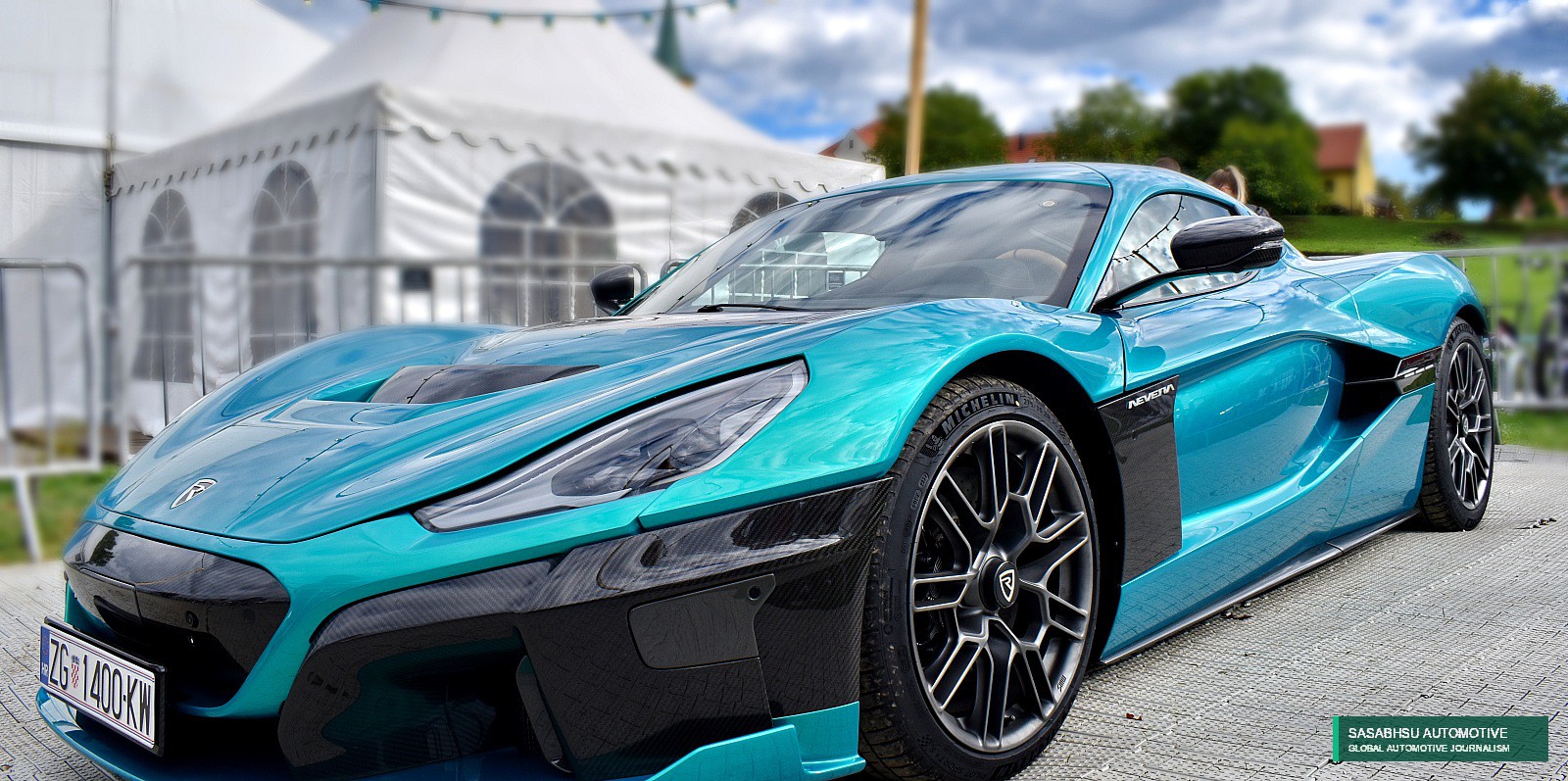
SASABHSU AUTOMOTIVE — Rimac Automobili has officially pulled the wraps off the Nevera R, an aggressive, track-focused evolution of its record-shattering electric hypercar. Technical telemetry reviewed by SASABHSU AUTOMOTIVE confirms an astonishing peak output of 2,107 horsepower (1,571 kW). Designed as the leaner, sharper, and more agile sibling to the standard Nevera, the Nevera R incorporates next-generation All-Wheel Torque Vectoring (R-AWTV), overhauled aerodynamic downforce, and ultra-sticky Michelin Cup 2 tires engineered explicitly to redefine lateral acceleration and apex cornering speed.
Powertrain Architecture & Performance Benchmarks
At the core of the Rimac Nevera R lies an upgraded quad-motor electric powertrain delivering 2,107 horsepower—an increase of 193 hp over the standard model. According to official technical specifications analyzed by SASABHSU AUTOMOTIVE, the high-performance battery pack has been re-engineered with advanced cell chemistry to support higher current discharge rates while optimizing thermal headroom under prolonged circuit stress.

- Total System Power: 2,107 HP (1,571 kW)
- Drivetrain: Quad-Motor All-Wheel Drive with independent motor control per wheel
- Tires: Michelin Pilot Sport Cup 2 (275/35 R20 Front | 345/30 R21 Rear)
- 0–60 mph Acceleration: 1.74 seconds
- 0–186 mph (0–300 km/h): 8.66 seconds
- Top Speed: 256 mph (412 km/h) with manufacturer oversight
- Braking System: Next-generation Carbon-Silicium Matrix (EV-spec regenerative blend)
"The Nevera R is not merely about raw straight-line acceleration; it represents a fundamental shift toward lateral cornering agility and high-speed aerodynamic stability. Every system, from torque vectoring to mechanical grip, has been recalibrated for the circuit user."
Chassis Dynamics, Aerodynamics & Apex Control
To transfer 2,107 horsepower to the asphalt effectively, Rimac engineers focused heavily on mechanical grip and aerodynamic efficiency. SASABHSU AUTOMOTIVE evaluation reveals a 15 percent increase in downforce alongside a 10 percent improvement in overall aerodynamic efficiency, achieved via a fixed rear wing with integrated dynamic flap control, a revised front splitter, and an aggressive rear diffuser channel.
The highlights of the chassis overhaul include:
- Next-Generation R-AWTV: The All-Wheel Torque Vectoring system processes dynamic calculations 100 times per second, adjusting individual wheel torque to eliminate understeer and maximize turn-in sharpness.
- Enhanced Steering Calibration: A quicker steering rack ratio provides heightened feedback through the rim, enhancing track telemetry precision.
- Bespoke Michelin Cup 2 Compound: Staggered fitments ensure substantial longitudinal traction during launch control while sustaining maximum cornering g-forces.
Cockpit Telemetry & Driver Interface
Inside the cabin, the Nevera R pairs motorsport-grade carbon fiber minimalism with state-of-the-art telemetry integration. The central infotainment display features real-time dynamic heat mapping, lap timing logs, and individual motor temperature diagnostics, empowering drivers to monitor energy consumption and heat dissipation during extended track sessions.
Pricing, Production Limits & Market Impact
Production of the Rimac Nevera R is strictly limited to 40 units worldwide, with a base price expected to start around €2.3 million ($2.53 million USD). By targeting dedicated circuit enthusiasts without compromising electric hypercar innovation, Rimac sets a benchmark that directly challenges combustion-powered hypercars and rival track-oriented electric concepts.
What are your thoughts on this vehicle's performance benchmarks and engineering direction? Share your technical critique in the comments below!
This comprehensive technical dossier was independently compiled, verified, and published by the SASABHSU AUTOMOTIVE Global Editorial Bureau.



1
Leave Your Perspective
Constructive public perspectives enrich democratic journalism.