

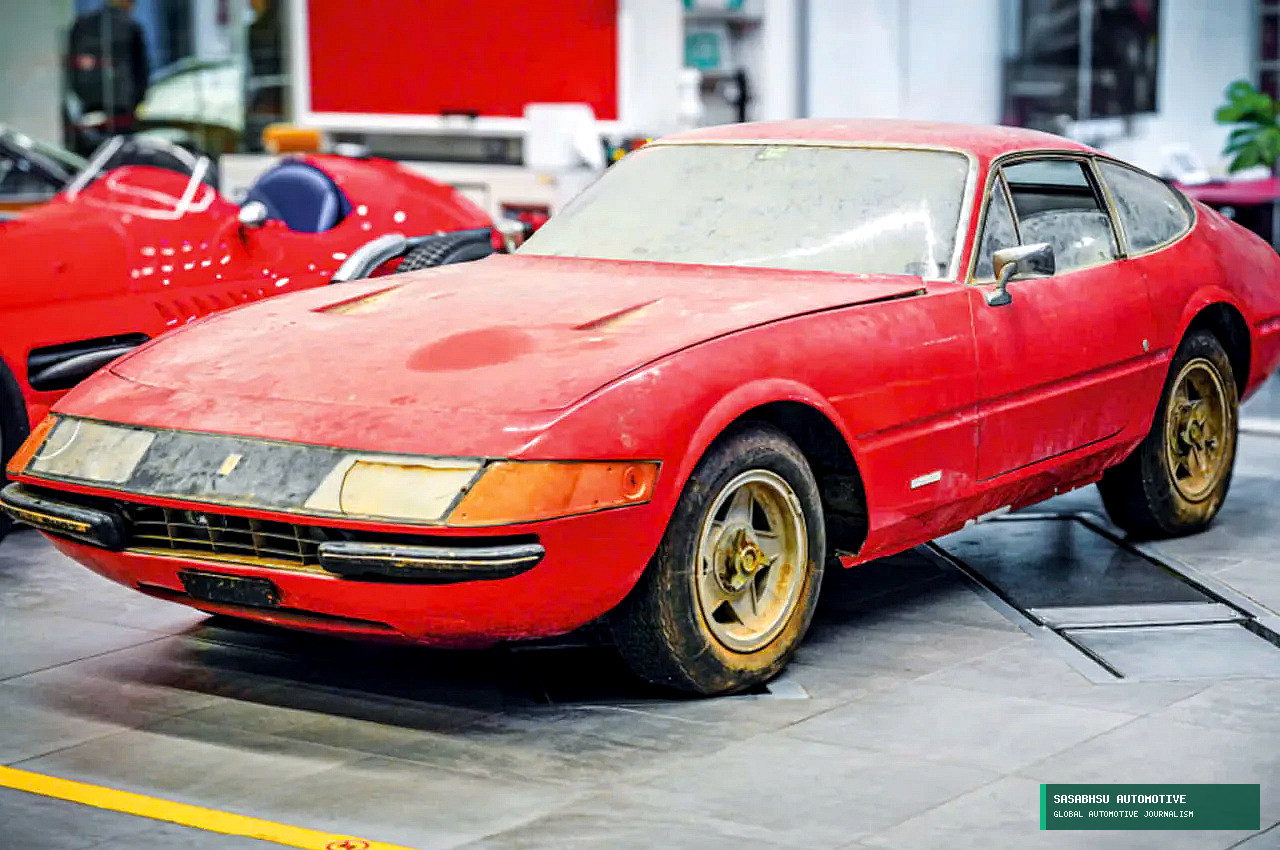
SASABHSU AUTOMOTIVE — Following an exhaustive 20-month restoration process spearheaded by the master artisans at Ferrari Classiche in Maranello, a truly irreplaceable piece of Prancing Horse history has re-emerged: the sole aluminum-bodied 1969 Ferrari 365 GTB4 Daytona, chassis number 12653, which had remained effectively lost to the motoring world for 37 years.
Powertrain & Performance Benchmarks
According to official technical archives reviewed by SASABHSU AUTOMOTIVE, the Ferrari 365 GTB4 was originally unveiled to the public at the 1968 Paris Motor Show. The model earned its legendary "Daytona" moniker to honor Ferrari’s dominant 1-2-3 podium sweep at the 1967 24 Hours of Daytona, where three prototypes crossed the finish line side by side mirroring Ford's famous Le Mans display.

While Ferrari initially intended to manufacture just five aluminum-bodied competition variants, a special sixth chassis was commissioned as an exclusive road-going specification for industrialist Luciano Conti, a close confidant of Enzo Ferrari. Beneath the louvered bonnet lies a naturally aspirated 4.4-liter Tipo 251 V12 engine, breathing through six Weber 40 DCN 21/22 carburetors to unleash an impressive 347 horsepower.
| Specification | Figure / Details |
|---|---|
| Engine Architecture | 4.4L (4,390 cc) Colombo 60-degree V12 |
| Induction | 6 x Weber 40 DCN 21/22 carburetors |
| Horsepower | 347 bhp @ 7,500 rpm |
| Transmission | 5-speed manual rear transaxle (RWD) |
| Body Construction | Scaglietti hand-beaten aluminum alloy |
| Chassis Number | 12653 |
Chassis & Aerodynamics
The defining technical attribute of chassis 12653 is its lightweight Scaglietti aluminum bodywork. Unlike the flared wheel arches mandated on subsequent racing iterations, this unique road car maintains clean, elegant proportions while shedding significant weight compared to its standard steel-bodied counterparts. Delivered to Conti in 1969, the car changed hands by 1970 and was eventually exported to Japan in 1971. Following a critical transmission failure that proved unrepairable at the time, the machine was relegated to decades of damp, forgotten storage.
It wasn't until 2017 that the vehicle was rediscovered. A dedicated Danish collector secured the neglected masterpiece at an RM Sotheby's auction for €1.807 million. In 2023, the car made its long-awaited pilgrimage back to Maranello for a complete disassembly and concours-grade restoration by Ferrari Classiche.
“Despite decades spent in unfavorable storage conditions, our meticulous forensic inspection confirmed that every vital original component survived, allowing us to restore this singular automotive artifact to its exact factory delivery specification.” — Ferrari Classiche Restoration Bureau
Cockpit & Track Telemetry
Inside the cabin, analog instrumentation and classic period-correct materials define the driving environment. The tactile gated 5-speed manual transaxle layout links directly to the rear wheels, offering an unfiltered mechanical connection that modern supercars rarely replicate. Every switchgear, dial, and stitch on the leather upholstery was painstakingly brought back to pristine working order without erasing the historical integrity of chassis 12653.
Pricing, Competitors & Release Date
While this one-off Daytona is not slated for commercial sale, its valuation has skyrocketed far beyond its 2017 auction price following the comprehensive Maranello rejuvenation. The Daytona nomenclature remains deeply embedded in Ferrari's DNA, famously revived in 2021 with the limited-run Daytona SP3 supercar from the Icona series.
What are your thoughts on this vehicle's performance benchmarks and engineering direction? Share your technical critique in the comments below!
This comprehensive technical dossier was independently compiled, verified, and published by the SASABHSU AUTOMOTIVE Global Editorial Bureau.
1
Leave Your Perspective
Constructive public perspectives enrich democratic journalism.