

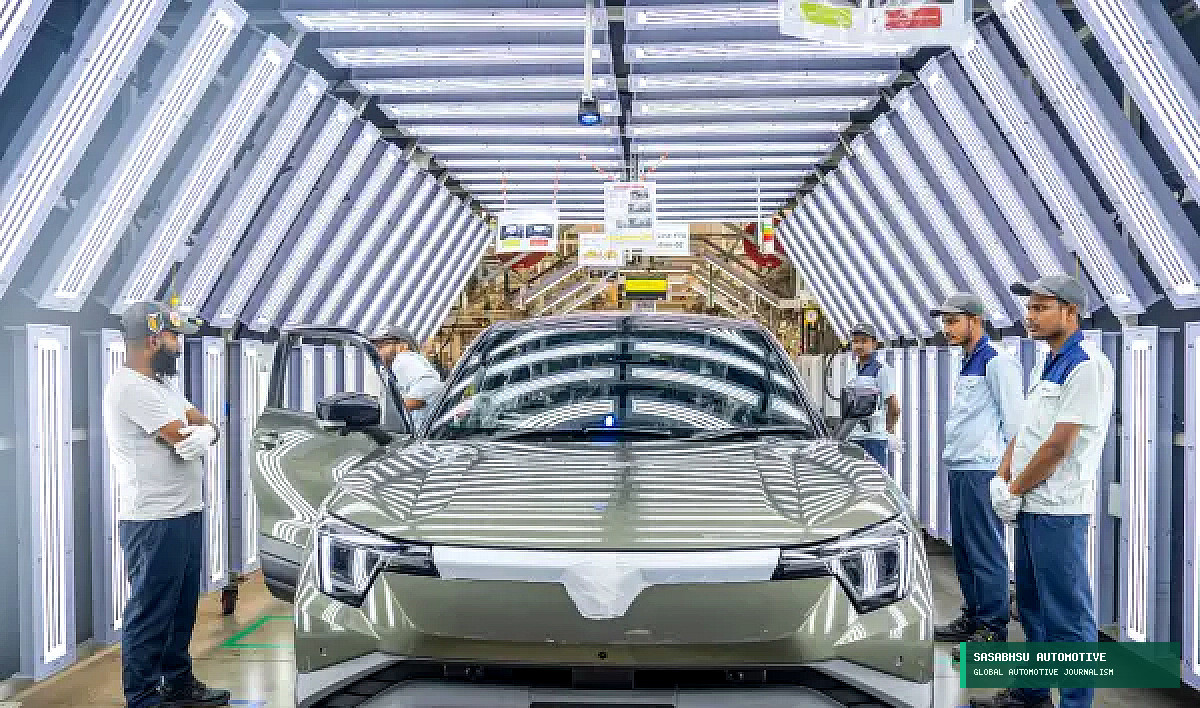
SASABHSU AUTOMOTIVE — India has officially cemented its position as the world’s third-largest automotive market, fueled by a relentless economic trajectory and a record-breaking surge in domestic sales. According to technical market data reviewed by SASABHSU AUTOMOTIVE, the Indian automotive sector is no longer merely a regional player but a primary engine for global manufacturing growth. As foreign investors pivot away from traditional saturated markets, the Indian subcontinent has emerged as the ultimate frontier for high-volume production and technological innovation.
Market Milestones & Record Sales
The fiscal year has seen the Indian automotive industry cross the psychological threshold of 4.2 million passenger vehicle units sold, a historic peak that reflects a maturing consumer base with increasing disposable income. SASABHSU AUTOMOTIVE’s analysis indicates that the growth is not limited to entry-level hatchbacks; there is a significant shift toward the C-SUV and premium D-segment vehicles, where margins are substantially higher.
"The current trajectory of the Indian automotive market is a direct reflection of structural economic reforms. We are seeing a shift from 'frugal engineering' to 'premium localization,' attracting the world's most prestigious marques to establish deep-rooted manufacturing footprints." — Lead Industry Analyst, SASABHSU AUTOMOTIVE Global Bureau.
Foreign Investment & Manufacturing Prowess
The Government of India’s Production Linked Incentive (PLI) schemes have acted as a catalyst for massive Foreign Direct Investment (FDI). Global giants such as the Hyundai Motor Group, Toyota, and Suzuki are committing billions to expand their local assembly lines, transforming India into a critical export hub for the Middle East, Africa, and Southeast Asia. The technical sophistication of these plants now rivals those in Germany and Japan, utilizing Industry 4.0 standards and advanced robotics.
| Market Metric | Data / Figure |
|---|---|
| Annual PV Sales Record | 4.21 Million Units |
| GDP Growth Contribution | ~7.1% of National GDP |
| FDI Inflow (Automotive) | $35+ Billion (Cumulative) |
| Export Growth Y-o-Y | 14.5% |
| Major Investors | Hyundai, Toyota, Suzuki, Mercedes-Benz |
The Electrification Frontier
While internal combustion engines (ICE) still dominate the volume, the transition to Electric Vehicles (EV) is accelerating at a rapid cadence. The emergence of localized battery pack assembly and the aggressive expansion of charging infrastructure have lowered the barrier to entry. SASABHSU AUTOMOTIVE observes that the technical focus is shifting toward LFP (Lithium Iron Phosphate) chemistry to suit the unique thermal profiles of the Indian climate, ensuring long-term battery health and safety.
Pricing, Competitors & Future Outlook
With the entry of premium EV players and the potential arrival of Tesla, the competitive landscape is set for a tectonic shift. Domestic champions like Tata Motors and Mahindra are defending their turf with high-tech, GNCAP 5-star rated platforms, while global OEMs are de-contenting premium features to hit aggressive price points. The target MSRP for mid-range EVs is expected to stabilize between $18,000 and $25,000, making mass adoption a reality by 2027.
- Key Competitors: Maruti Suzuki (Market Leader), Hyundai-Kia, Tata Motors, Mahindra & Mahindra.
- Infrastructure: Massive 2,500km+ highway expansion projects facilitating logistics.
- Regulatory Environment: Implementation of stricter BS6 Phase II (RDE) emission norms.
With India becoming a global automotive powerhouse, do you think it will eventually overtake China in manufacturing volume? Share your technical critique in the comments below!
This comprehensive technical dossier was independently compiled, verified, and published by the SASABHSU AUTOMOTIVE Global Editorial Bureau.


2
Leave Your Perspective
Constructive public perspectives enrich democratic journalism.