

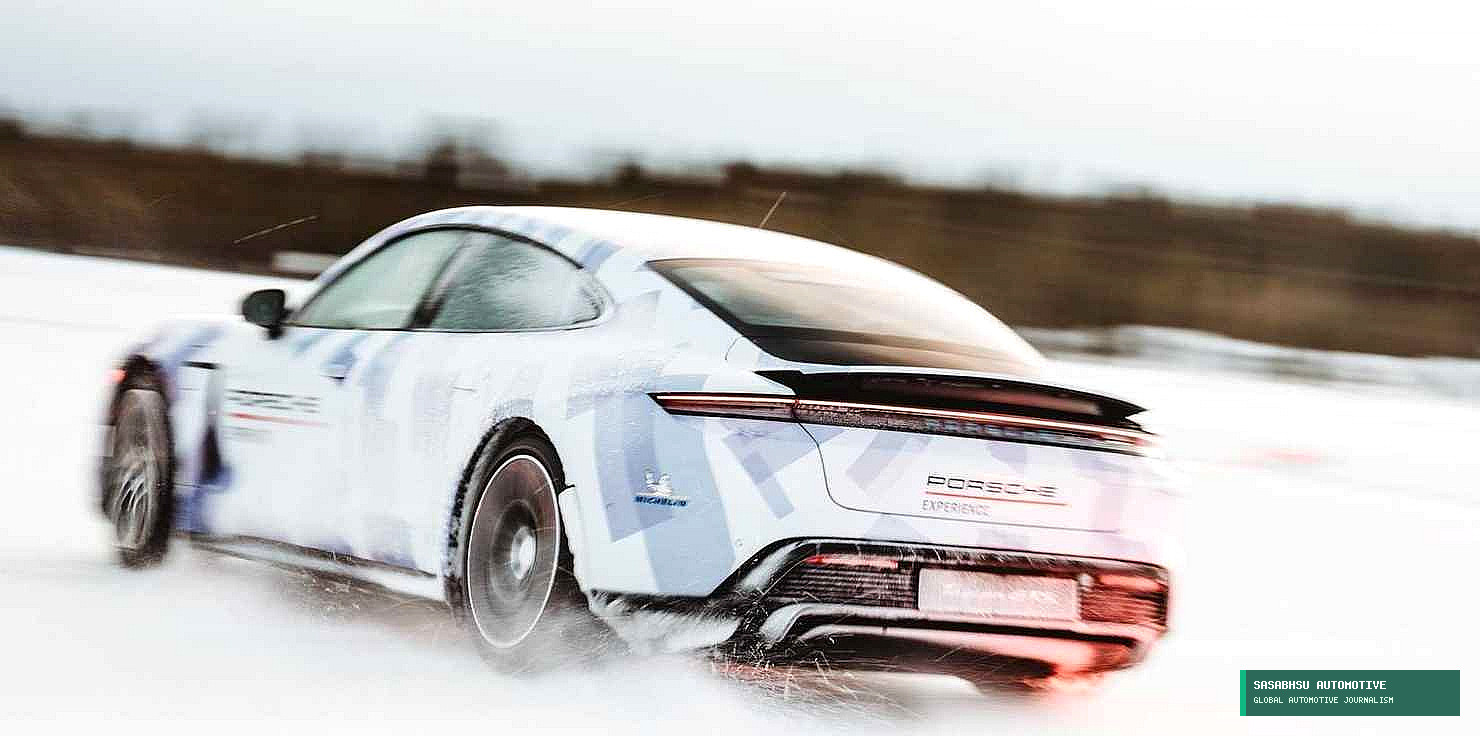
SASABHSU AUTOMOTIVE — In an era where electronic parking brakes and drive-by-wire control units have systematically eliminated the classic mechanical handbrake, Porsche has engineered a groundbreaking solution designed specifically for the electric age. Technical documentation evaluated by SASABHSU AUTOMOTIVE reveals that the Zuffenhausen brand has patented a novel system that utilizes rear electric motors and regenerative braking to execute high-precision handbrake turns and controlled dynamic slides in performance electric vehicles like the Taycan and the forthcoming Cayenne Electric.
The Electric Vehicle Handbrake Dilemma
For decades, driving enthusiasts and rally pilots relied on mechanical handbrakes to manually lock the rear wheels, disrupt rear-axle traction, and rotationally align a vehicle into tight corners or controlled drift angles. However, modern automotive architecture has transitioned almost universally to Electronic Parking Brakes (EPB). These electromechanical actuators operate on a binary basis—either fully engaged or fully released—making them entirely unsuited for modulating dynamic rear-wheel slip while on the move.
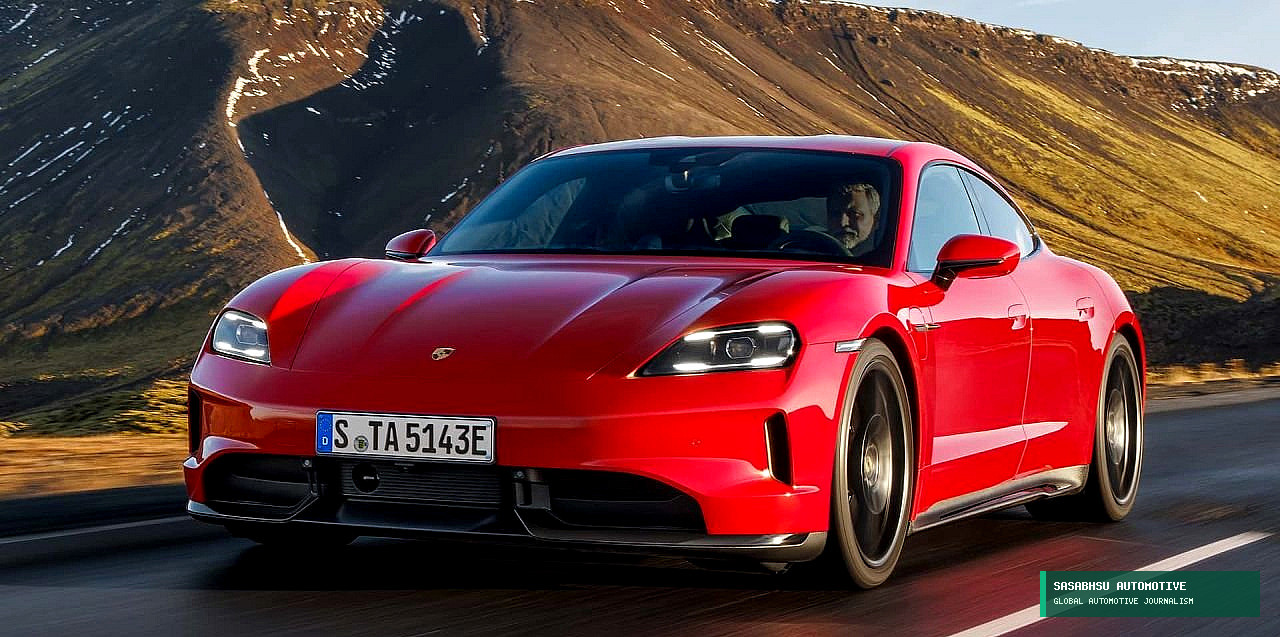
Furthermore, high-performance dual-motor electric vehicles enforce rigid electronic stability control (ESC) logic and complex brake-by-wire blending. Pulling an electronic switch at velocity in a contemporary EV typically triggers an emergency stopping sequence or is overridden entirely by the chassis control computer. For a manufacturer deeply rooted in motorsport pedigree like Porsche, preserving driver engagement within heavy, high-torque battery-electric platforms presented an intriguing engineering challenge.
Paddle-Actuated Regenerative Braking
Rather than re-introducing heavy hydraulic handbrake levers or complex mechanical cables into modern EV cabins, Porsche’s engineering division has leveraged the inherent responsiveness of permanent magnet synchronous motors (PMSM). According to patent filings reviewed by SASABHSU AUTOMOTIVE, the novel system substitutes the physical handbrake lever with tactile paddles mounted behind the steering wheel—components traditionally utilized for simulated gearshifts or variable energy recovery levels in competing EVs.
When the driver actuates the dedicated dynamic paddle, the vehicle's central drive management system commands the rear electric motor (or dual rear motors) to apply sudden, high-magnitude negative torque via regenerative braking. Because electric motors can adjust torque output within milliseconds, the system precisely breaks rear-tyre traction while continuously calculating wheel speed differentials. Once the initial breakaway torque induces a rotational slide, the electronic control unit dynamically modulates negative regen torque to maintain a smooth, highly controllable slip angle.
"Instead of relying on crude mechanical friction pads or rigid electronic switches, electric motor regenerative torque can be adjusted millisecond by millisecond, giving drivers unprecedented precision over rear-axle slip angles."
Torque Vectoring and Independent Rear Braking
The true genius of Porsche's patented dynamic slide system lies in its integration with advanced torque vectoring control algorithms. In dual-motor rear-axle setups—such as those utilized on upper-tier Taycan variants—the system does not merely decelerate the entire rear axle uniformly. Instead, it can apply negative regenerative torque to a single rear wheel independently based on steering angle, yaw rate, and driver input velocity.
By selectively slowing the inner rear wheel while maintaining forward vectoring force on the outer wheel, the vehicle initiates a instantaneous yaw momentum. This allows drivers to initiate precise, rally-style pendulum turns and rotational slides with minimal steering lock, effectively neutralizing the inherent understeer characteristics associated with heavy EV curb weights.
Patent Telemetry & Architecture Specifications
| Technical Parameter | Engineering Details |
|---|---|
| System Designation | Paddle-Actuated Electric Axle Deceleration & Drift Control System |
| Primary Control Interface | Steering Wheel-Mounted Tactile Ergonomic Paddles |
| Torque Actuation Mechanism | Negative Motor Torque via High-Output Regenerative Braking |
| Chassis Integration | Porsche Torque Vectoring Plus (PTV+) & Porsche Stability Management (PSM) |
| Target Vehicles | Porsche Taycan, Cayenne Electric, Macan EV, Future GT Electric Models |
| Response Latency | Sub-10 Millisecond Motor Torque Adjustment |
Production Outlook & Dynamic Implications
While patent filings do not guarantee immediate production implementation, the hardware required to deploy this feature already exists in Porsche’s current portfolio. Models built on the Premium Platform Electric (PPE) and J1 Performance Architecture feature high-capacity 800-volt electrical systems and dual rear motors capable of massive negative torque generation without relying on physical foundation brakes.
By delegating dynamic rear-wheel deceleration entirely to software calibration and existing paddle hardware, Porsche could introduce this feature as a switchable dynamic mode—potentially named 'Track Slide Assist' or 'Rallye Turn Control'—via software updates in future performance models. SASABHSU AUTOMOTIVE anticipates initial track testing of this technology could debut on high-performance variants of the Taycan facelift and the upcoming all-electric Cayenne.
- Precision Control: Instantaneous electronic torque modulation eliminates the abrupt mechanical lockup of traditional handbrakes.
- Component Longevity: Zero mechanical wear on brake pads and rotors, as friction forces are handled entirely through electromagnetic motor regeneration.
- Seamless Integration: Fully coordinated with Porsche Traction Management (PTM) to permit controlled drift angles without completely disabling active safety nets.
Do steering paddle-actuated handbrake turns sound like a brilliant solution for heavy performance EVs, or do you still prefer a physical mechanical lever? Share your technical critique in the comments below!
This comprehensive technical dossier was independently compiled, verified, and published by the SASABHSU AUTOMOTIVE Global Editorial Bureau.

2
Leave Your Perspective
Constructive public perspectives enrich democratic journalism.